

A dark academia bedroom works because it feels like a place you’d want to stay up reading in. It pairs deep, moody color with warm wood, soft pools of lamplight, and books you can reach from bed. The fastest way to get the look is to combine one rich wall color (forest green, burgundy, or charcoal) with warm brass lighting and a visible stack of books, then layer in wood, wool, and velvet from there. Everything else is seasoning.
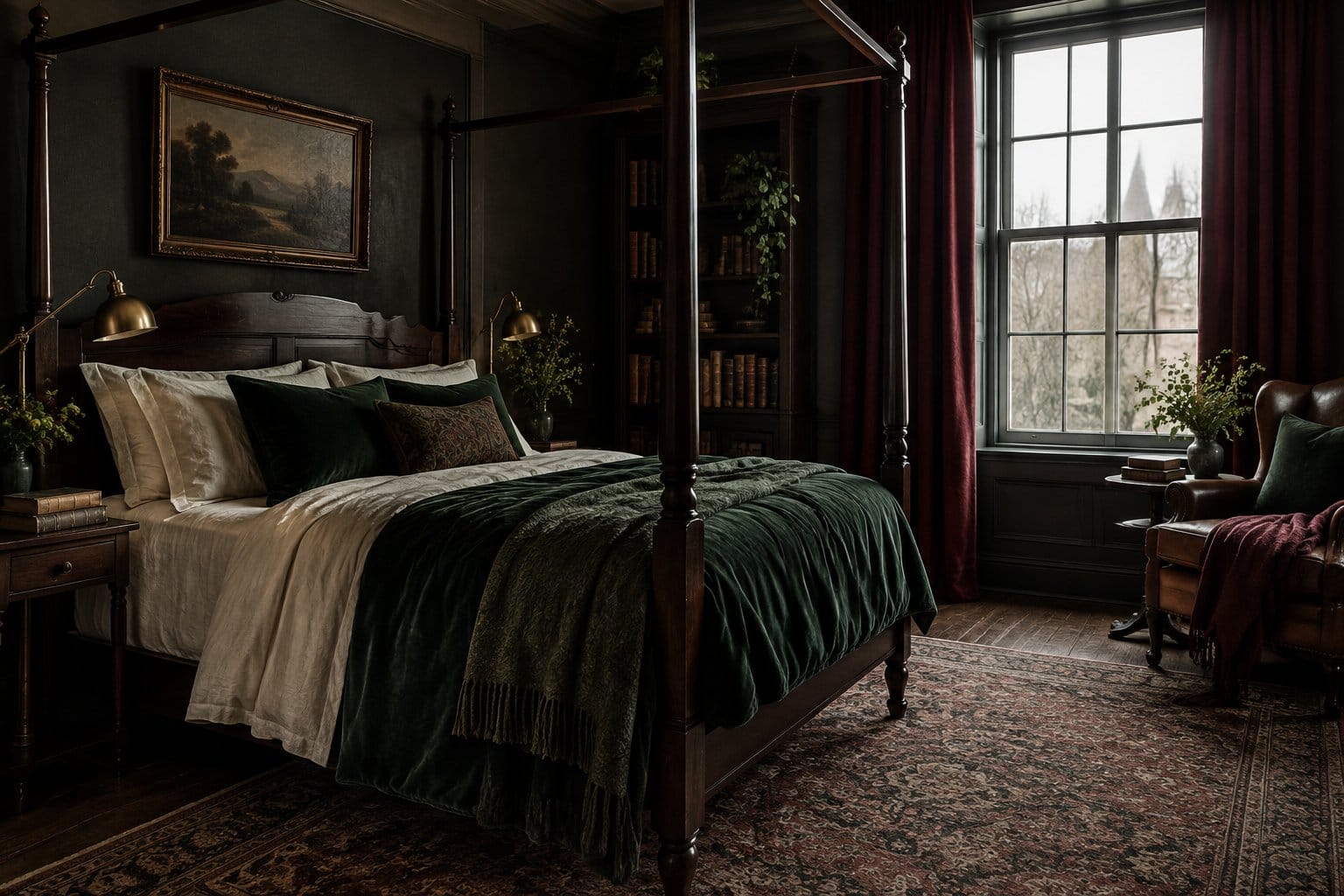
The catch is that dark rooms get gloomy fast if the lighting is wrong. They also get expensive fast if you assume everything has to be a genuine antique. The ideas below mix big moves like paint, built-ins, and a statement bed with renter-friendly swaps, sneaky storage, and lighting tricks that keep rich colors cozy at night and livable by day.
Some of these take a weekend, and some take ten minutes. Pick the one that excites you most and start there. Your future self, curled up with a novel under a brass lamp, will thank you.
1) Paint the Walls Forest Green with Warm Cream Trim
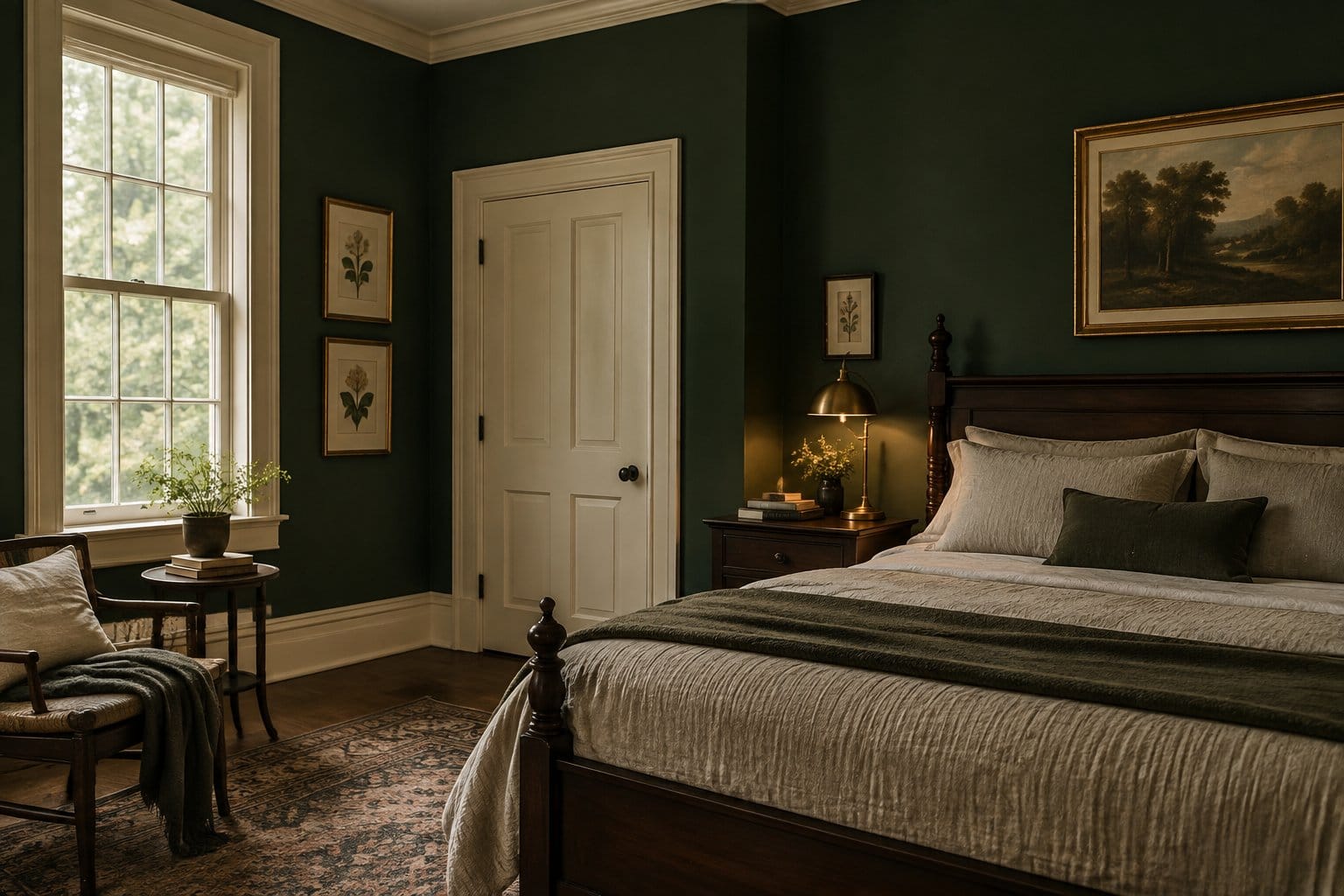
Forest green is the single most transformative change you can make, and it costs about as much as a couple of gallons of paint. It reads as moody at night and calm during the day. Wood furniture looks richer against it, too.
The cream trim is what keeps it from feeling like a cave. Pure white against deep green looks stark and a little clinical. A warm cream or antique white on the baseboards, window casings, and door frame softens the contrast and echoes old paper and parchment.
A few practical notes:
- Finish: Use matte or eggshell on walls to hide imperfections and give that velvety depth. Use semi-gloss on trim so it wipes clean.
- Test first: Paint a large swatch on two walls and look at it morning and night. Greens shift a lot under warm bulbs.
- Coverage: Dark colors often need a tinted primer plus two coats. Budget time accordingly.
If committing to four walls feels like a lot, paint just the wall behind your bed. You still get the drama, and it’s a far easier afternoon.
2) Build a Wall of Bookshelves Around the Bed
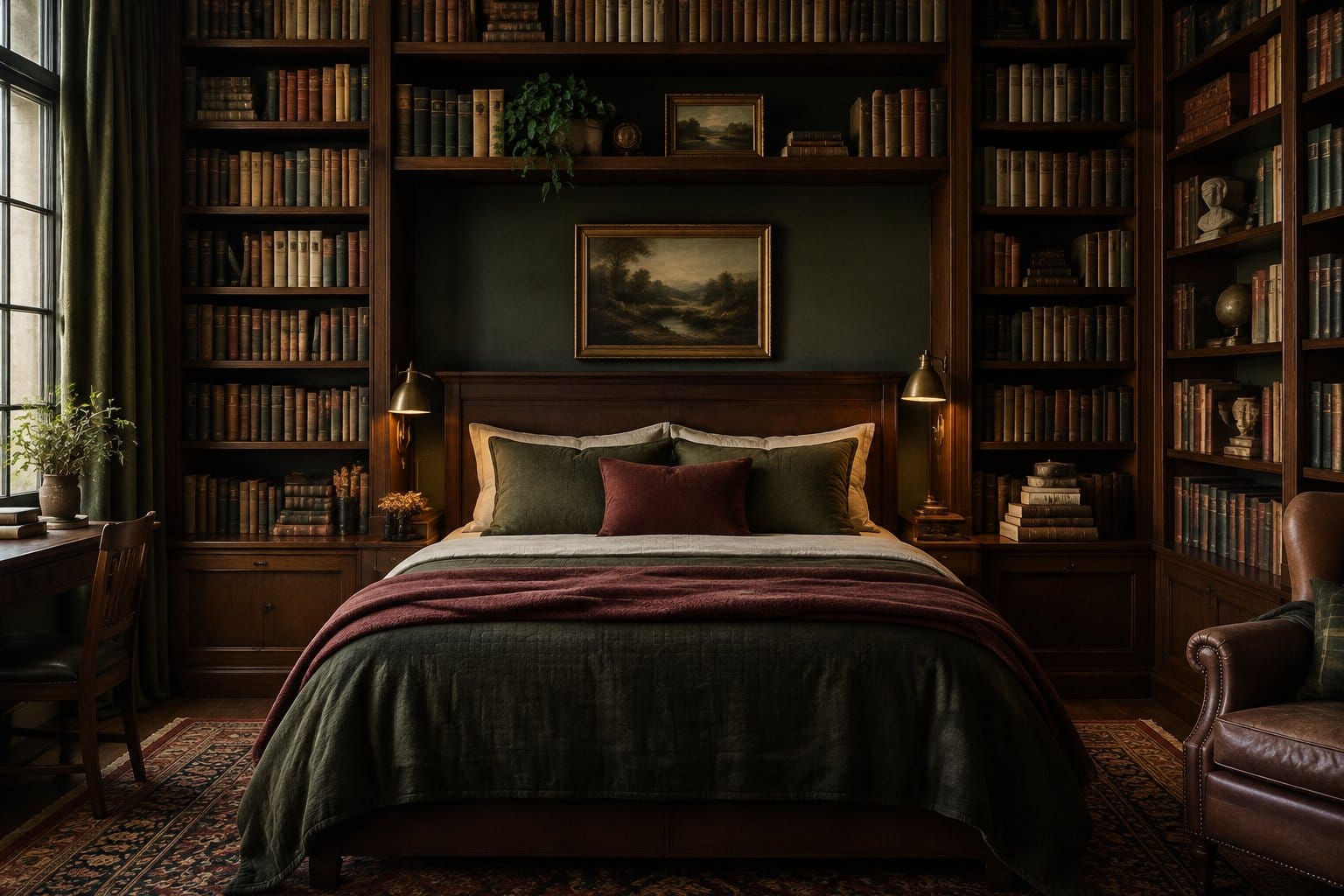
Shelving that wraps around your bed turns the whole wall into a private library, and it’s the most “you live here now” move on this list. It also solves the eternal problem of where your books go.
You don’t need custom carpentry. Two tall flat-pack bookcases on either side of the bed, plus a shallow shelf or cabinet bridging over the headboard, get you 90% of the built-in look. Add crown molding across the top and paint everything the same color as the wall, and people will assume it was always there.
Anchor everything to the wall. Tall bookcases full of hardcovers are heavy, and you do not want one tipping while you sleep. Keep the heaviest books on lower shelves.
Styling tips that keep it from looking like a warehouse:
- Mix vertical rows with horizontal stacks.
- Leave a little breathing room on every shelf.
- Tuck in a few objects: a small plant, a candlestick, a framed print.
A pair of heavy fleur-de-lis bookends keeps half-filled shelves tidy while your collection grows.
3) Choose a Carved Walnut Bed Frame
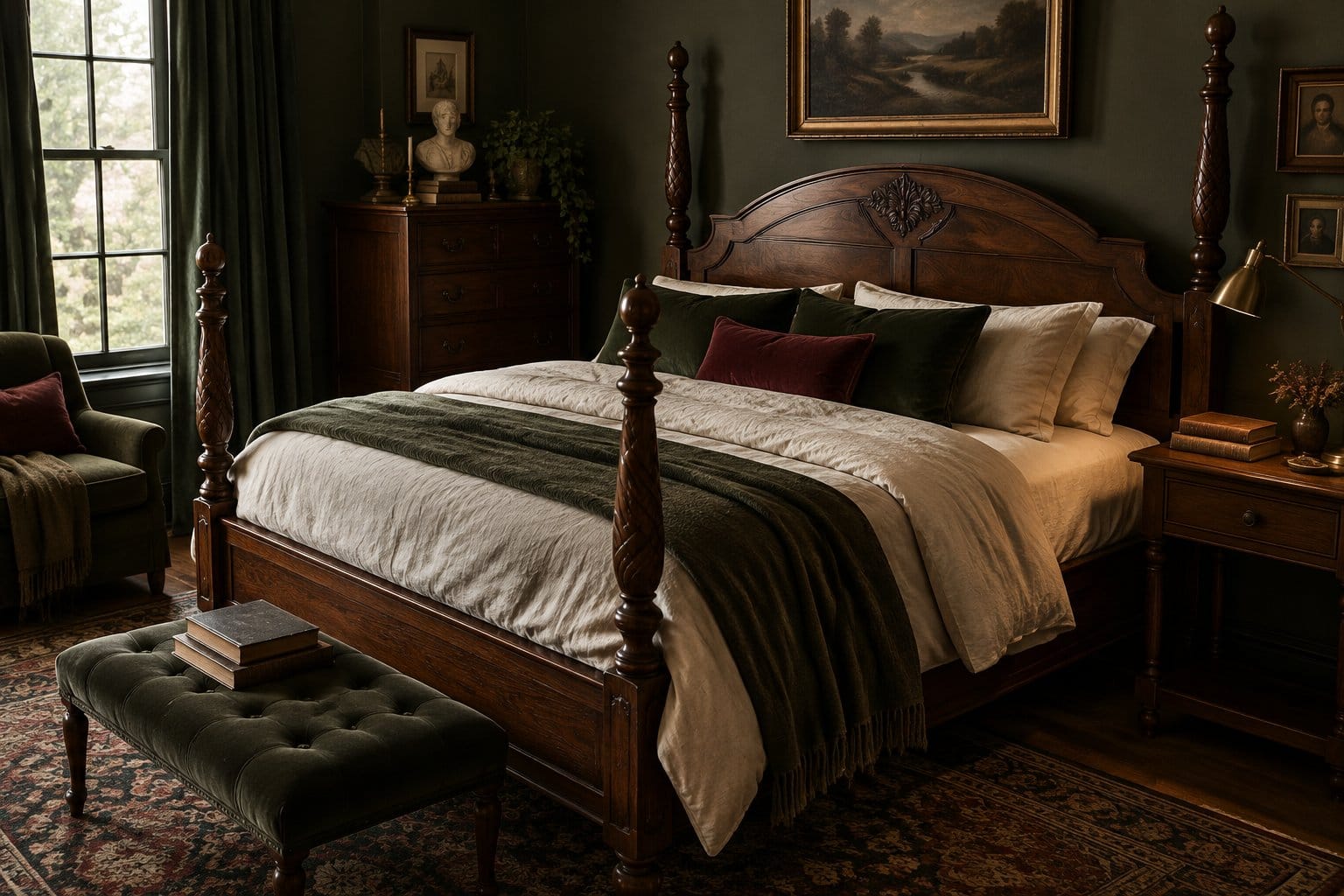
Your bed is the biggest piece of furniture in the room, so a carved wooden frame sets the tone for everything around it. Walnut’s warm, chocolatey grain looks right at home next to green or burgundy walls.
Honest talk: new carved hardwood beds are pricey. Estate sales, auction houses, and online marketplaces are where the deals live, because heavy antique beds are hard to move and sellers often just want them gone. Bring a tape measure. Older frames were frequently built for full-size mattresses, and a queen won’t fit.
Things to check on a secondhand frame:
- Side rails and hardware: Make sure all pieces are present and the joints are solid.
- Mattress support: Many antiques need slats or a bunkie board added.
- Height: Tall headboards look amazing but can crowd a low ceiling.
If a full carved frame isn’t in the budget, a carved wooden headboard alone gives you the focal point for a fraction of the cost. Mount it to the wall and keep your existing metal frame hidden under the bedding.
4) Layer Burgundy Velvet Bedding Over Crisp Cotton Sheets
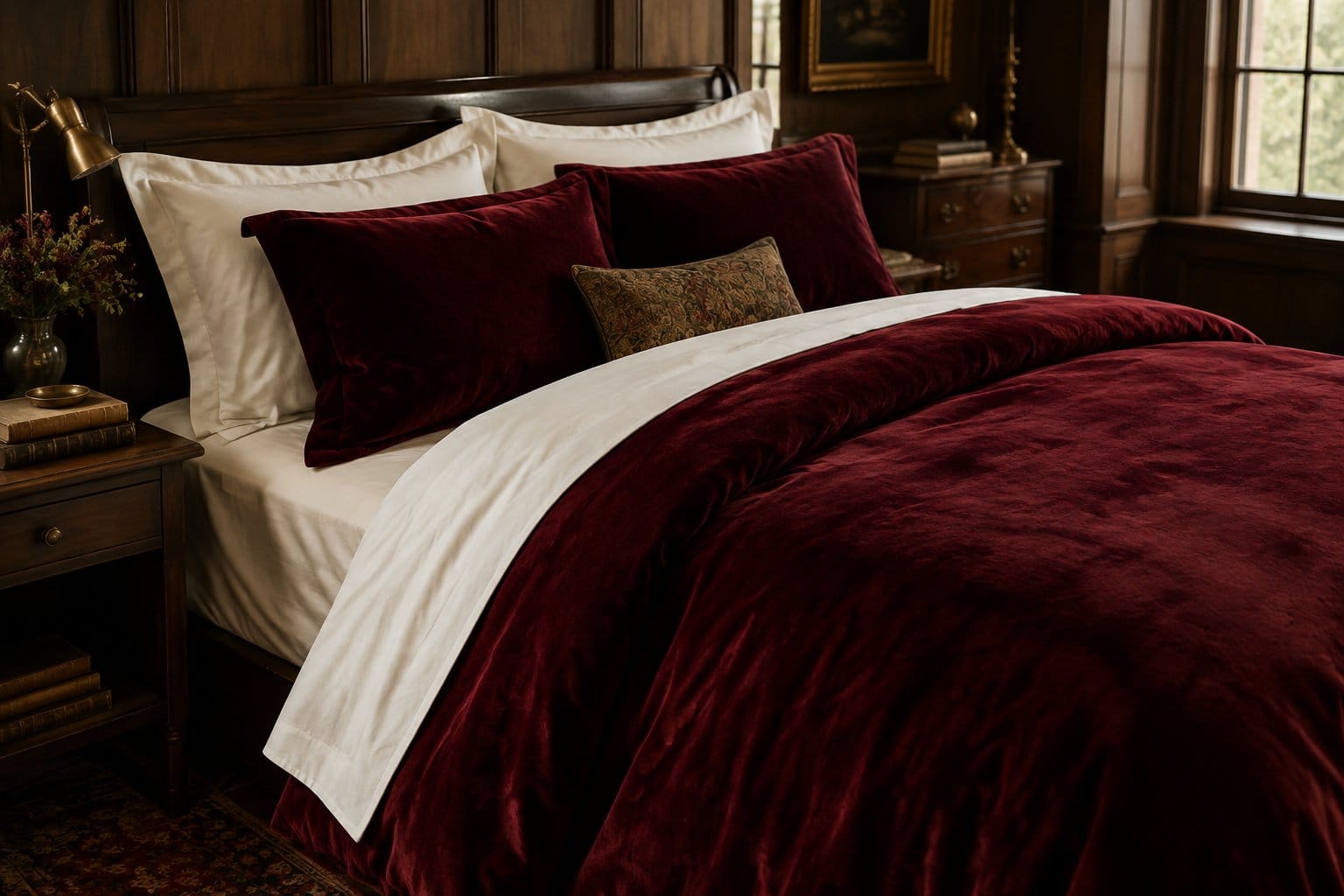
Burgundy velvet makes a bed look luxurious in seconds, and the crisp cotton underneath keeps it comfortable to sleep in. Velvet next to your skin all night can feel warm and a little clingy. Cotton percale or sateen sheets give you that cool, fresh feel.
Here’s the layering order that works:
- White or cream cotton sheets, with the top sheet folded back over the duvet.
- A burgundy velvet quilt or duvet cover.
- Two sleeping pillows in white cases, plus one or two velvet shams in front.
The white fold of the top sheet is the trick. It adds a clean stripe of contrast that makes the burgundy look richer and the bed look intentionally made.
Upkeep reality check: Velvet shows pet hair and crush marks. Look for washable polyester velvet if you have animals or hate dry cleaning. A lint roller becomes your new best friend. Shake the quilt out each morning and the pile evens back out.
5) Add a Vintage Writing Desk
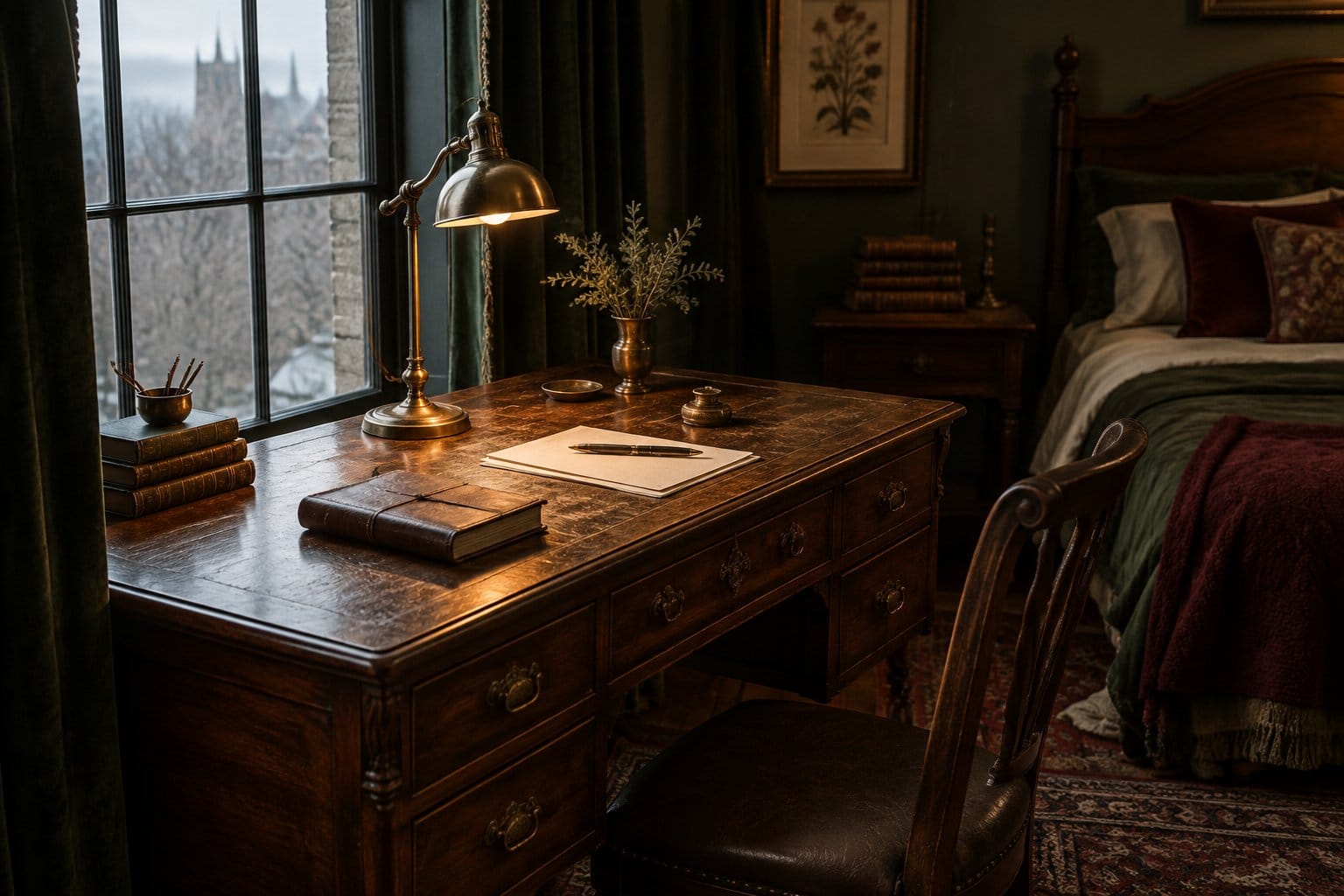
A writing desk gives the room its scholarly heart, and it earns its floor space by doing double duty as a nightstand, vanity, or laptop spot. Place it under or beside a window so you get natural light for daytime journaling.
Secondhand is the way to go here. Small wooden writing desks turn up constantly at thrift stores and flea markets because they’re too small for most home offices. Look for:
- Solid wood with dovetailed drawers.
- A width of 36 to 42 inches for small bedrooms.
- Legs you can see under, which makes a room feel bigger than a bulky pedestal base.
Secretary desks with fold-down fronts are fantastic for tight rooms. You close the lid and your mess disappears.
Keep the surface edited: a lamp, a stack of two or three books, a pen cup, and one notebook. Clutter reads as “dorm room” faster than anything else. Pair it with a wooden chair with a caned or upholstered seat, and skip the rolling office chair if you can.
6) Lay Down a Faded Persian-Style Rug
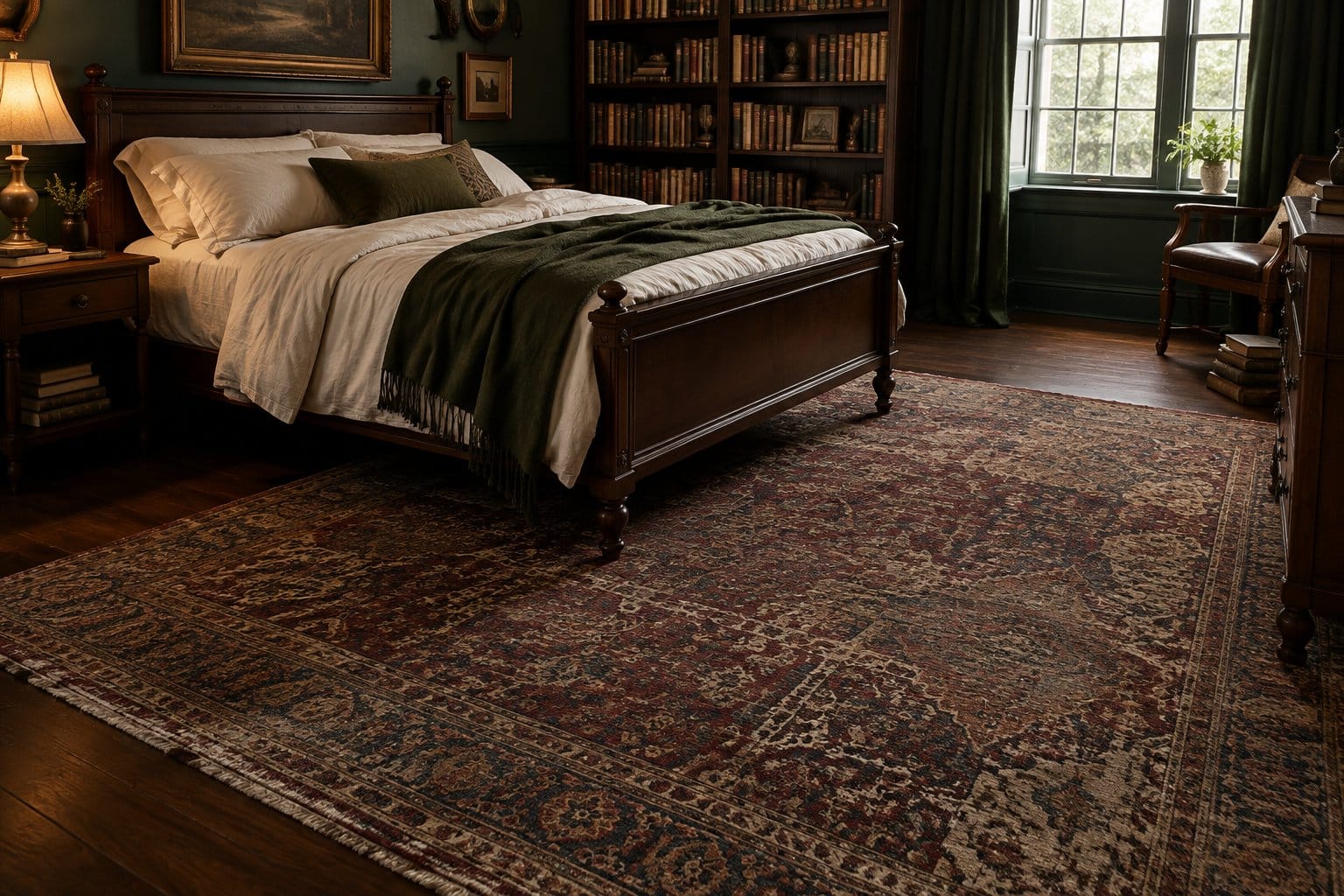
A faded, pattern-heavy rug adds warmth underfoot and makes a new room look like it has history. The worn, sun-bleached look is what you’re after. Saturated brand-new reds can feel loud next to dark walls.
You have two main routes. Vintage wool rugs are gorgeous and durable but can run into serious money. Machine-made “distressed” or “vintage-style” rugs in low pile give you the look for much less, and many are easy to vacuum. Something like the Loloi Loren collection rug in blue and red captures that faded heirloom feel.
Sizing rule: The rug should extend at least 18 to 24 inches past the sides of the bed so your feet land on it when you get up. For a queen bed, that usually means 8×10. In smaller rooms, place the rug under the bottom two-thirds of the bed.
Always add a rug pad. It stops slipping, protects hardwood, and makes cheaper rugs feel noticeably plusher.
7) Hang Velvet Curtains from Brass Rods
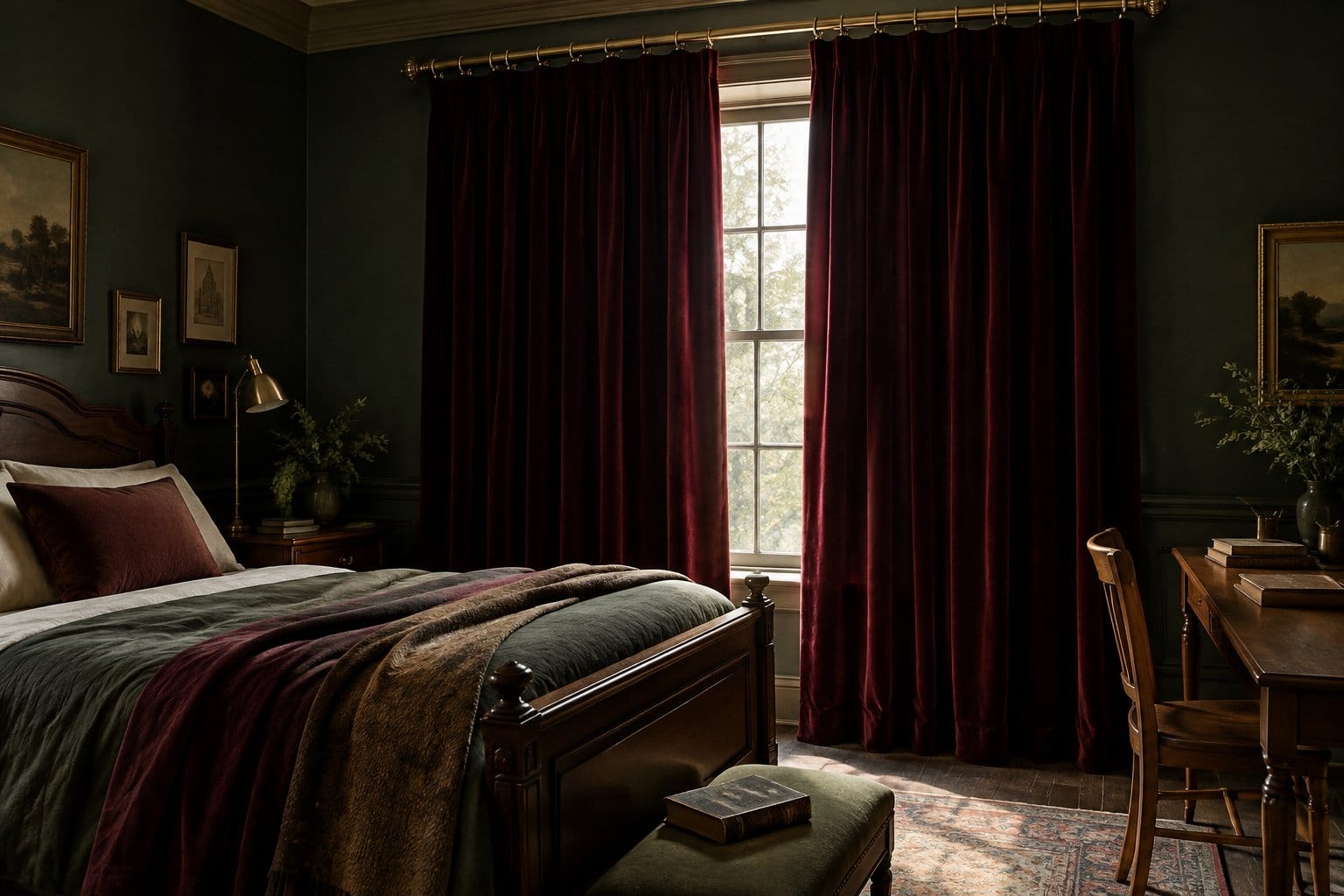
Floor-length velvet curtains on a brass rod make any window look grander, and they help you sleep. Heavy fabric blocks light and softens echo, which a room full of hard wood furniture needs.
Hang the rod higher and wider than the window:
- Mount it 4 to 6 inches below the ceiling or crown molding.
- Extend it 8 to 12 inches past each side of the frame.
- Let the panels just kiss the floor or break by an inch.
This tricks the eye into reading the window as taller and bigger, and when the curtains are open, the glass stays fully uncovered for maximum daylight.
Color-wise, burgundy, emerald, and deep navy all work. If you want serious light blocking, look for lined options like these burgundy thermal blackout curtains, which also help with drafty windows in winter.
Brass rods with simple ball finials look period-appropriate without getting fussy.
8) Light the Room with Brass Library Lamps
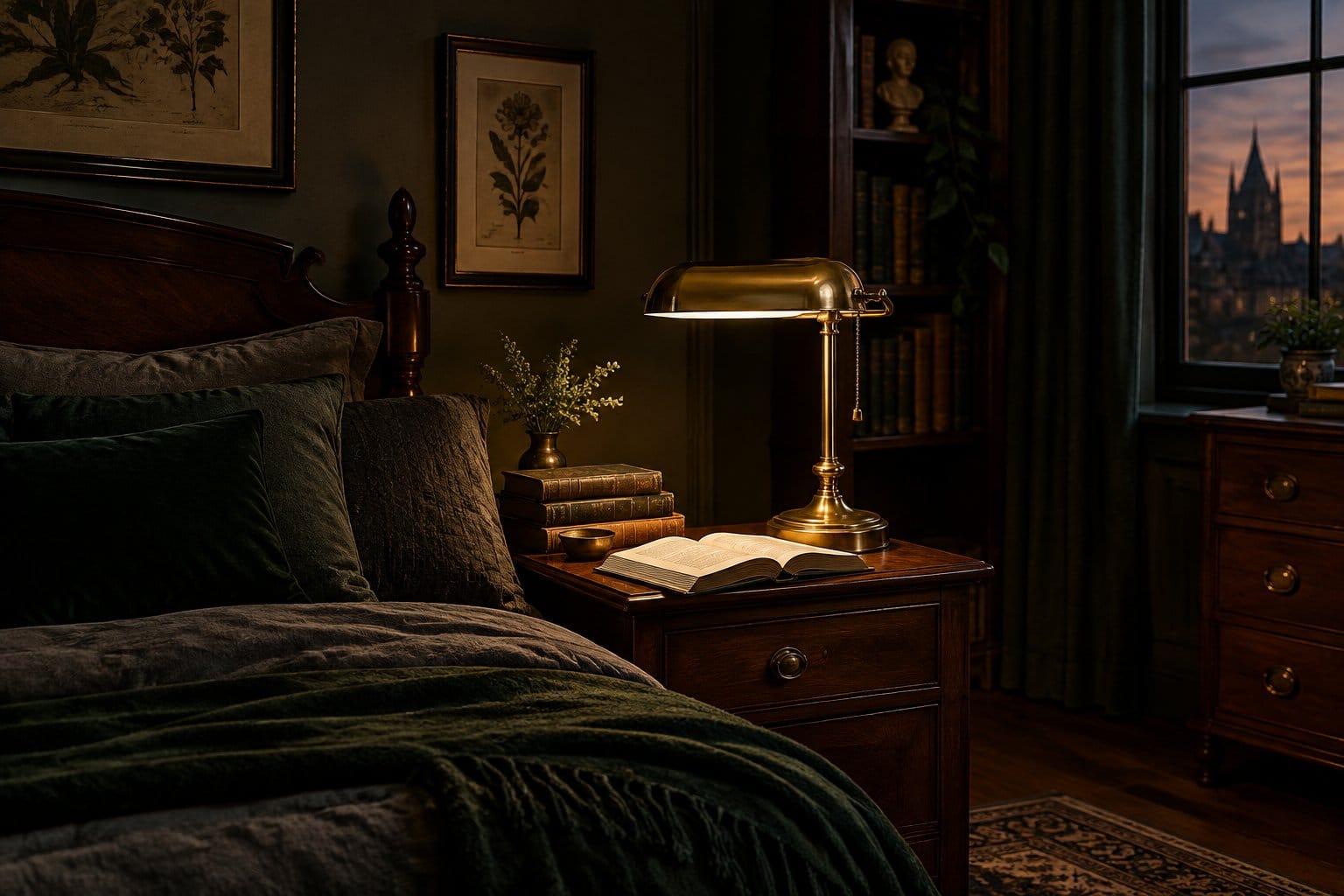
Lighting is what makes dark colors feel cozy instead of gloomy, and brass library lamps are the workhorses. A room lit only by a ceiling fixture will look flat and shadowy no matter how pretty your walls are.
Aim for at least three light sources at different heights:
- Bedside: A brass lamp on each nightstand, or a swing-arm wall lamp if surfaces are tight.
- Desk: A classic banker’s lamp with a green glass shade.
- Accent: A picture light over art or bookshelves.
Bulbs make or break it. Use warm white bulbs around 2700K. Anything cooler turns green walls murky and makes burgundy look brown. Dimmable bulbs or plug-in dimmers let you drop to a candlelit glow for winding down.
Plug-in wall sconces are a lifesaver if you don’t want to hire an electrician. Run the cord down the wall with a paintable cord cover and it nearly vanishes against dark paint.
9) Set Up a Leather Wingback Reading Chair
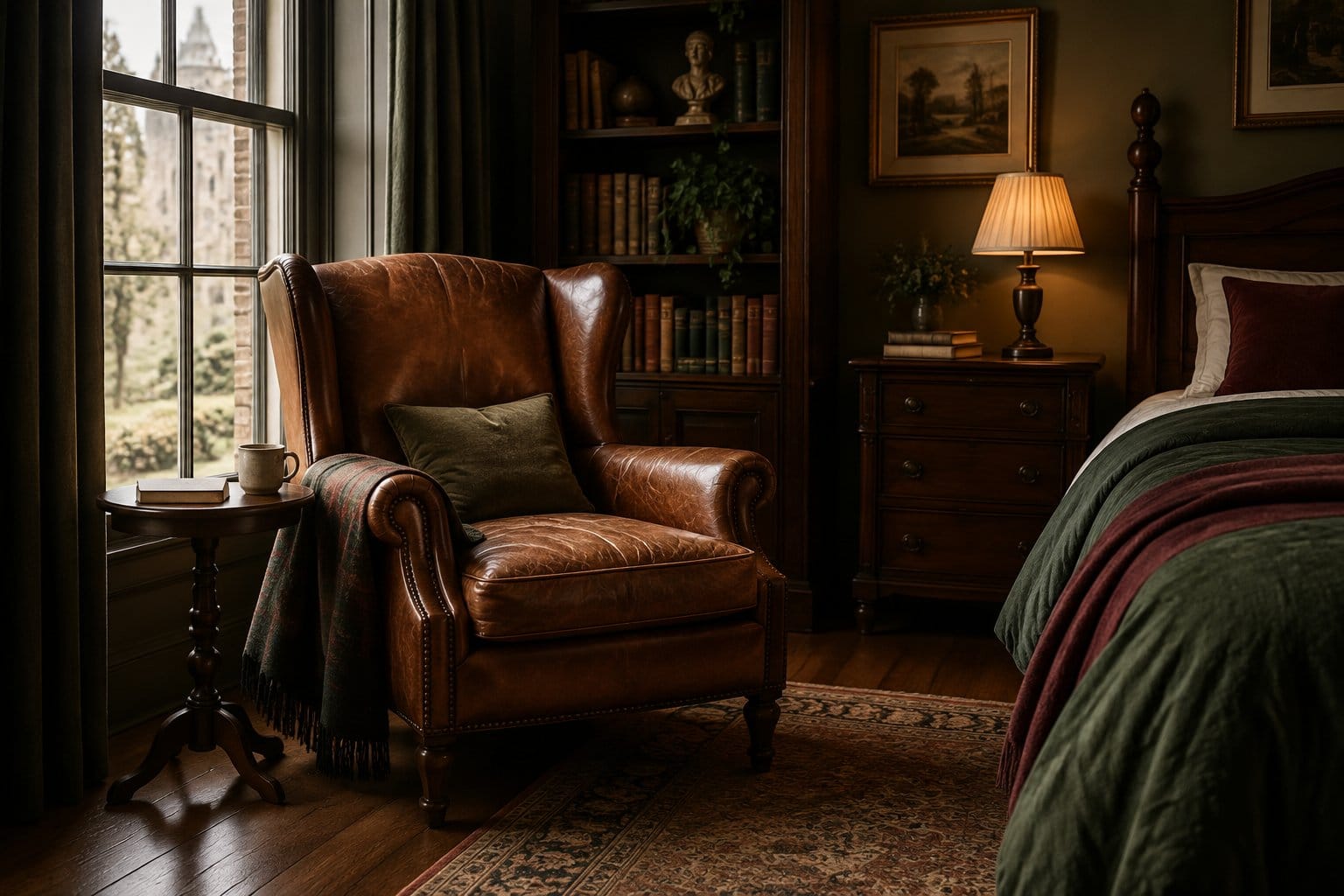
A wingback chair gives you a dedicated reading spot that isn’t your bed, which is surprisingly good for sleep. Those tall wings also cocoon you and block drafts, the reason they were invented in the first place.
Put it in a corner near a window with a small side table and a floor lamp positioned over your shoulder. That’s the whole nook. Add a folded throw on the arm and a footstool if you have room.
About the leather: genuine aged leather develops a gorgeous patina but costs a lot new. Secondhand leather chairs are widely available, and slightly worn ones look better anyway. Faux leather is cheaper but can crack and peel within a few years. A tweed or velvet wingback is a great alternative if leather isn’t your thing.
Measure before you buy. Wingbacks run deep, often 30 inches or more, and they look larger in person than in photos. Tape the footprint on your floor and live with it for a day.
10) Drape a Tartan Wool Throw Across the Bed
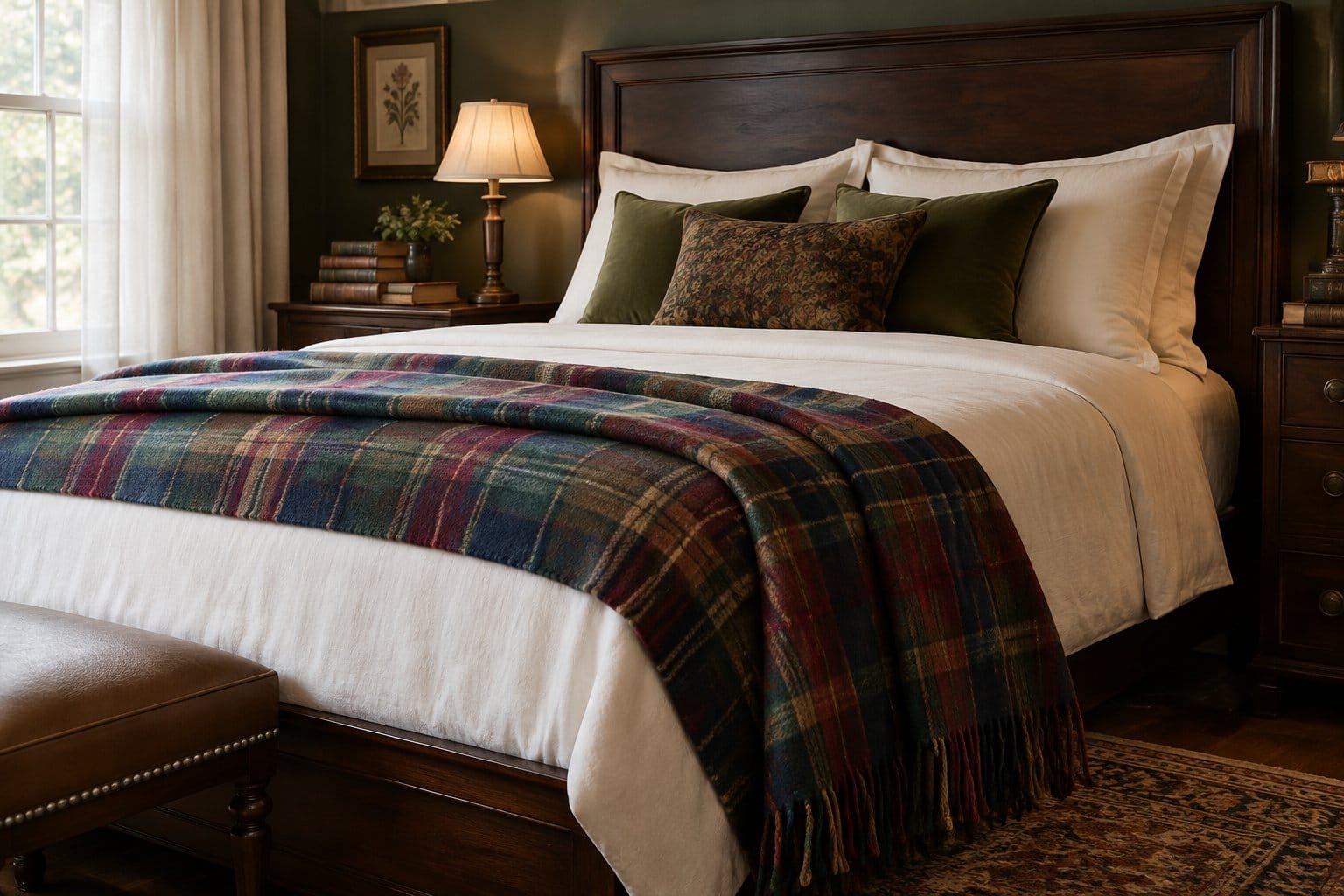
A tartan wool throw is the quickest, cheapest way to make a bed look like it belongs at a drafty old university. It adds pattern, texture, and actual warmth in one move.
Fold it lengthwise into thirds and lay it across the foot of the bed, covering the bottom quarter. That clean band looks tidy and gives your feet an extra layer on cold nights. Keep a second one on your reading chair if you get chilly.
Choosing colors: pick a tartan that repeats one or two colors already in your room. A green-and-navy Black Watch pattern suits forest green walls. A red-based Royal Stewart plays well with burgundy bedding.
Pure wool is warm, breathable, and resists odors, but it can feel scratchy and usually needs a gentle cold wash or dry cleaning. Lambswool and merino are softer. A wool-blend throw is a good compromise if you’re sensitive or want something machine-washable. Moths love wool, so store off-season throws with cedar blocks.
11) Frame Antique-Style Botanical Prints
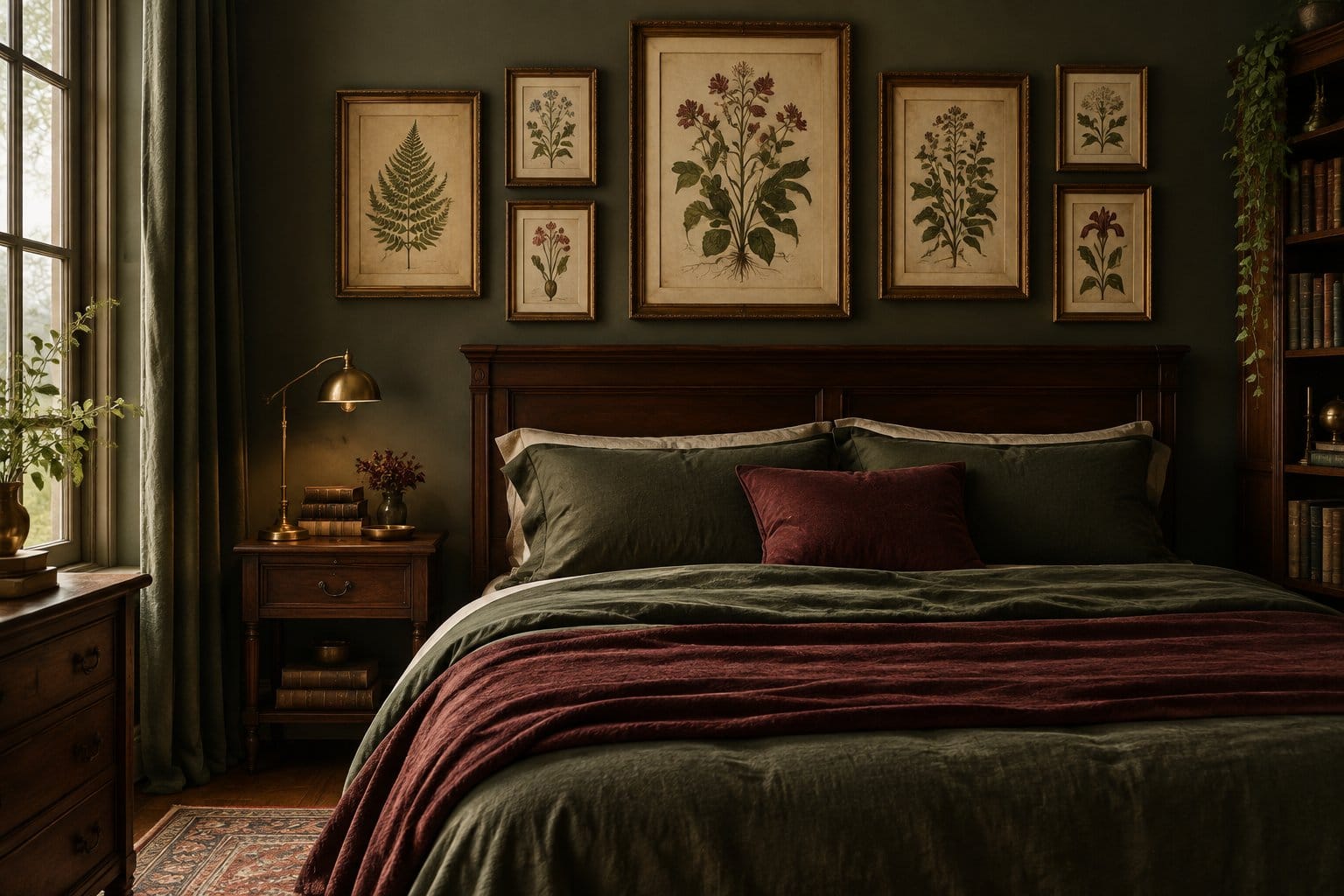
Botanical prints bring a scholarly, natural-history feel to your walls, and they cost next to nothing. Many old scientific illustrations are in the public domain, which means you can download high-resolution scans from museum and library digital collections and print them yourself.
Print on matte, cream-toned paper for an aged look. Glossy photo paper screams “new.”
Framing ideas that look expensive:
- A matched grid: Four or six prints in identical thin wood or gold frames, hung above the bed in a tight grid with 2 to 3 inches between.
- A mixed gallery: Varied frame sizes grouped on one wall, anchored by a larger central piece.
- Wide mats: A generous cream mat makes even a small print feel important.
Thrift store frames are perfect here. Swap the art, spray-paint the frame gold or dark bronze if needed, and you’re done.
Ferns, mushrooms, and medicinal herbs fit the dark academia mood best. Hang art so the center sits about 57 inches from the floor, or 8 to 10 inches above your headboard.
12) Try Removable Damask Wallpaper Behind the Bed
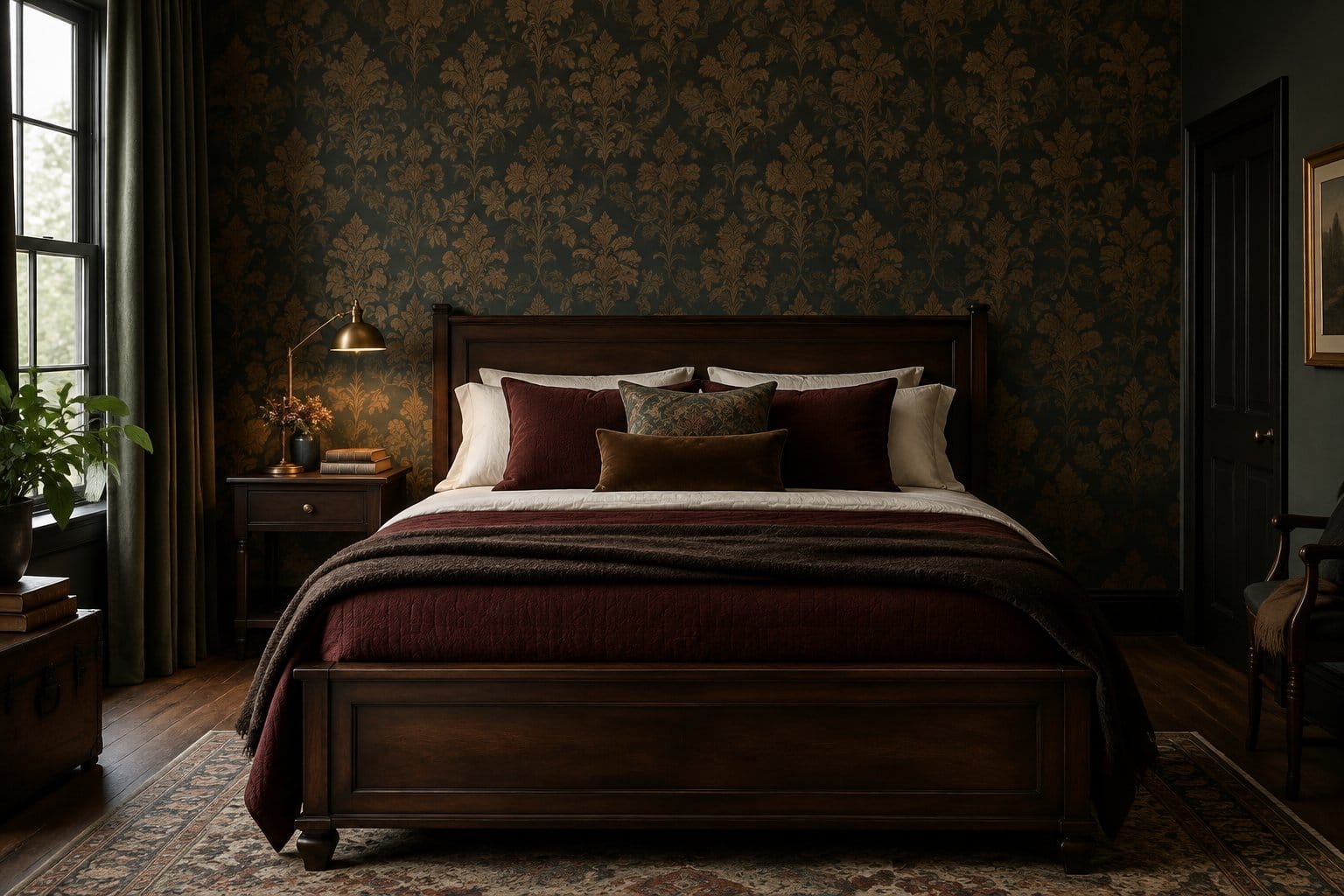
Peel-and-stick damask wallpaper gives you a Victorian feature wall without a landlord conversation. Stick to one wall, the one behind your bed, so the pattern feels like a headboard backdrop and doesn’t overwhelm the room.
Tone-on-tone patterns look most sophisticated. Black on charcoal, deep green on green, or subtle gold on burgundy all read as rich and old-world. Something like this black vintage damask peel-and-stick wallpaper is an easy starting point.
Application tips from people who’ve fought with it:
- Clean walls first. Wipe away dust so the adhesive grips.
- Match the pattern before you peel more than a few inches of backing.
- Use a smoothing tool and work from the center out to push out bubbles.
- Buy one extra roll. Pattern matching eats material.
Heads up: peel-and-stick struggles on textured walls and in humid rooms, and it can pull paint on removal if the paint underneath is fresh or cheap. Test a small piece in a corner first.
13) Prop Up a Gilded Vintage Mirror
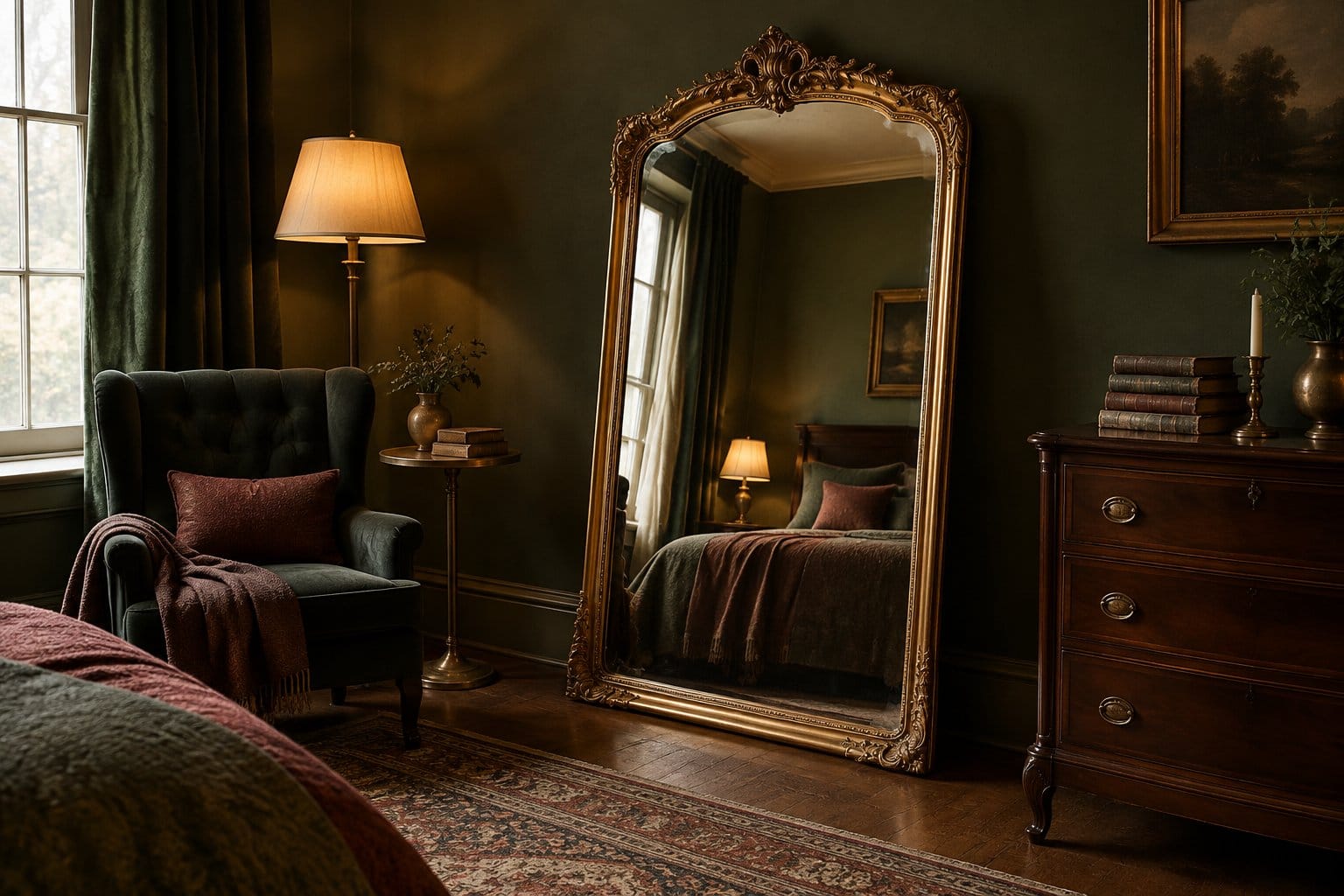
A large gilded mirror bounces light around a dark room and adds a hit of old-world glamour. It’s one of the most useful tools for keeping rich wall colors from feeling heavy.
Leaning it on the floor or on top of a dresser feels relaxed and renter-friendly, with no hanging hardware needed. Place it across from or beside a window to double your daylight.
For a floor mirror, secure it anyway. A small anti-tip strap screwed discreetly into the wall behind the frame prevents disasters with pets, kids, or your own elbow.
Gold frames look best slightly worn, with some rub-through showing darker color underneath. Brand-new shiny gold can look costume-y. If yours is too bright, a thin wipe of dark wax or brown glaze settles it down.
Smaller spaces can use a wall-hung ornate piece instead. This gold baroque mirror with candle holders doubles as a light source when paired with flameless candles, which leads nicely into the next idea.
14) Use Brass Candlesticks with Flameless Tapers
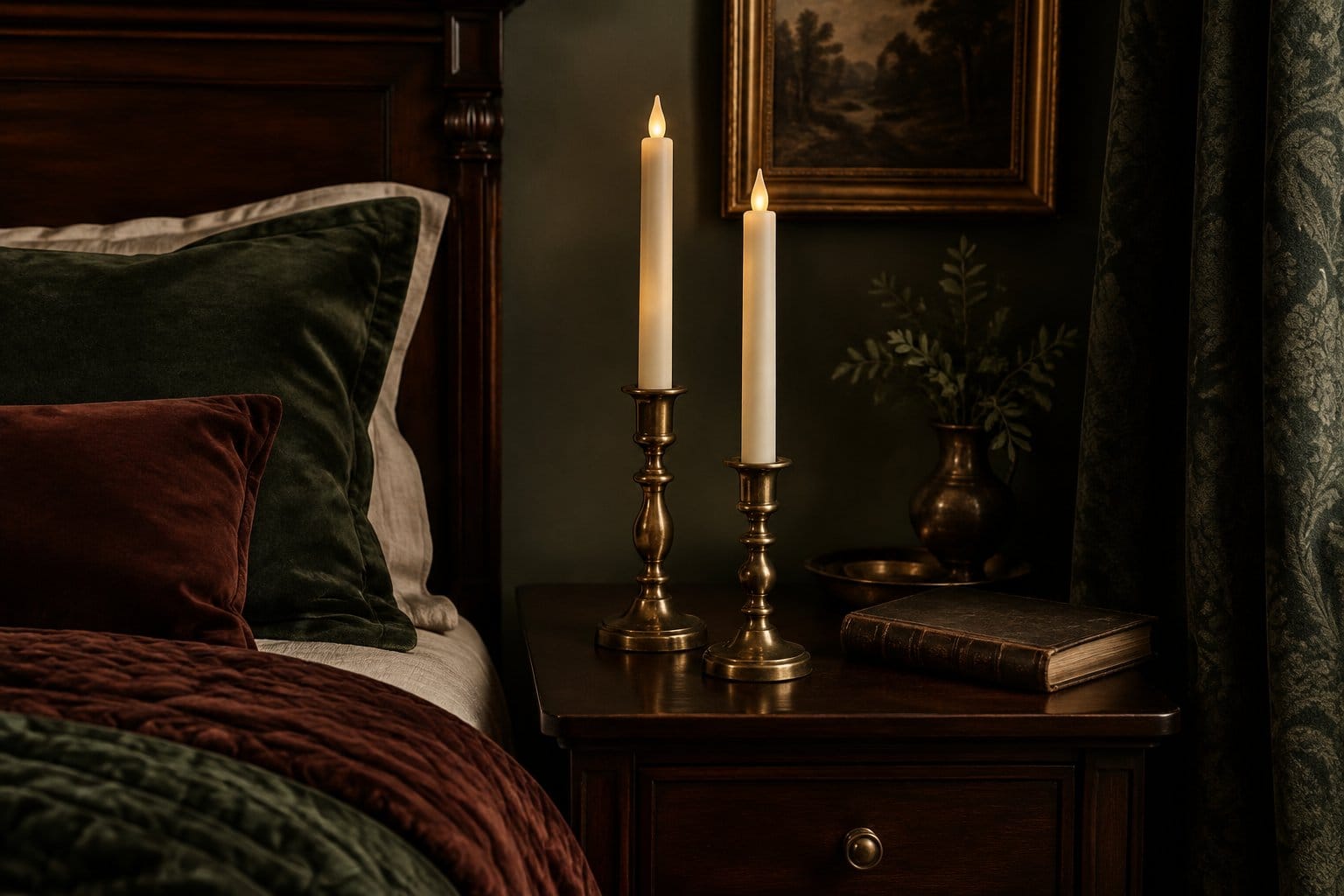
Brass candlesticks with flameless tapers give you the candlelit mood without the fire risk of falling asleep next to an open flame. Bedrooms, books, curtains, and wool throws are a flammable combination, so this swap is a smart one.
Good flameless tapers have a few telltale features:
- Real wax exteriors that look convincing up close.
- Flickering warm-white LEDs, avoiding blue-toned ones.
- Remote control or timers, so you can switch them on from bed.
Timers are the unsung hero. Set them to come on at dusk for a few hours and your room glows every evening without you lifting a finger.
Hunt thrift stores for brass candlesticks. They turn up constantly, often tarnished and cheap. Mismatched heights grouped in threes or fives on a dresser or windowsill look intentionally collected. You can polish them bright, or leave some tarnish for an aged look.
Ivory or cream tapers look classic. Dark green or burgundy ones tie into your palette for extra drama.
15) Store Spare Linens in a Vintage Steamer Trunk
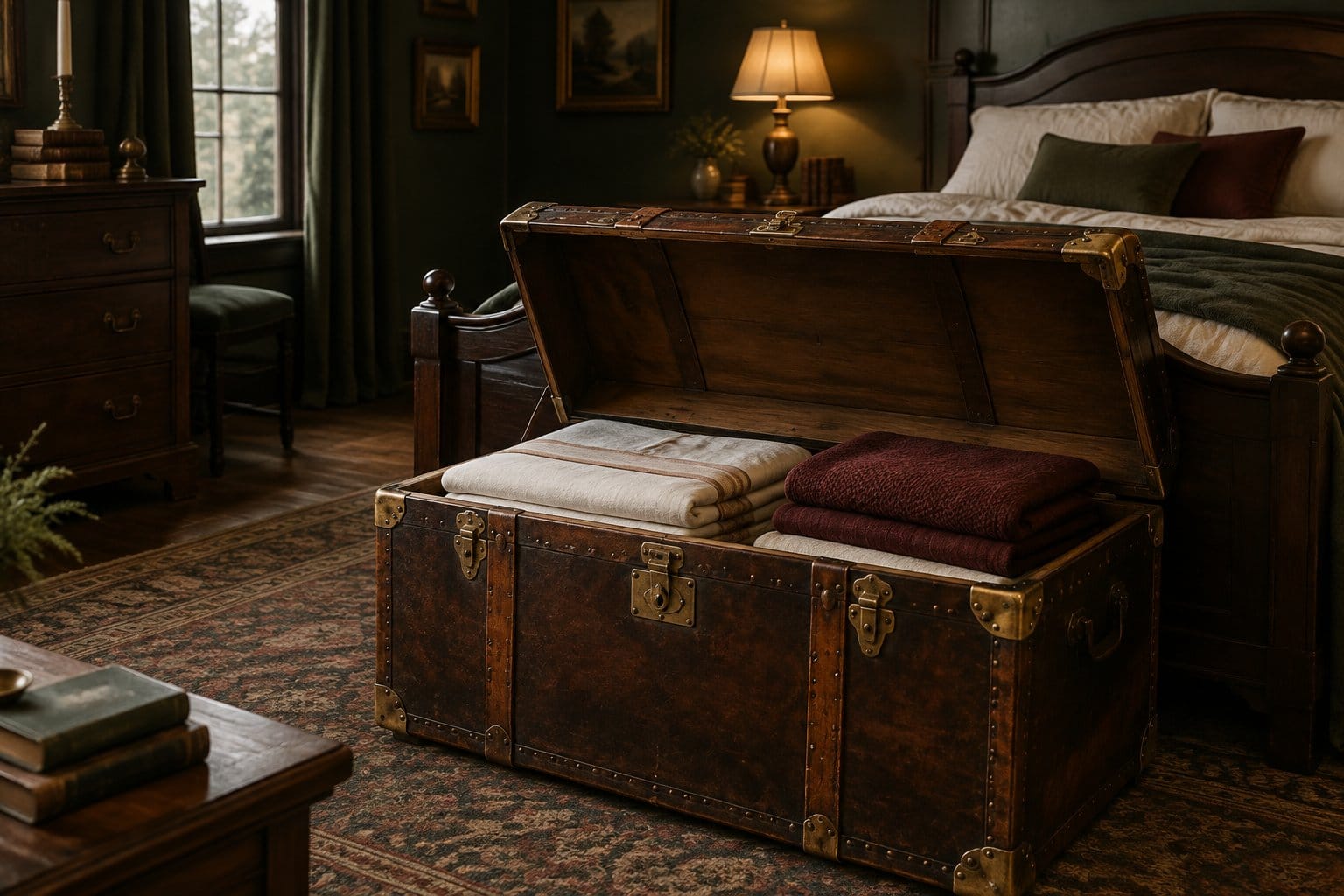
A steamer trunk at the foot of the bed is storage that looks like décor. Spare sheets, winter blankets, and extra pillows go inside, and the lid becomes a spot to sit while putting on shoes or to stack tomorrow’s reading.
Old trunks turn up at antique malls, estate sales, and online marketplaces. Check before buying:
- Smell: Musty odors are common. Airing it outside, wiping the interior with diluted vinegar, and leaving an open box of baking soda inside for a week usually fixes it.
- Hinges and latches: Make sure the lid stays open without slamming.
- Lining: Torn paper linings can be replaced with wallpaper or fabric.
Always line the inside with a clean cotton sheet or pillowcases before storing linens. Old wood and paper can transfer stains or smells onto fabric.
If a real trunk is too heavy or pricey, a wooden storage bench or a reproduction trunk gives the same function. Lay a folded throw on top to soften it.
16) Refresh a Dresser with Apothecary-Style Drawer Pulls
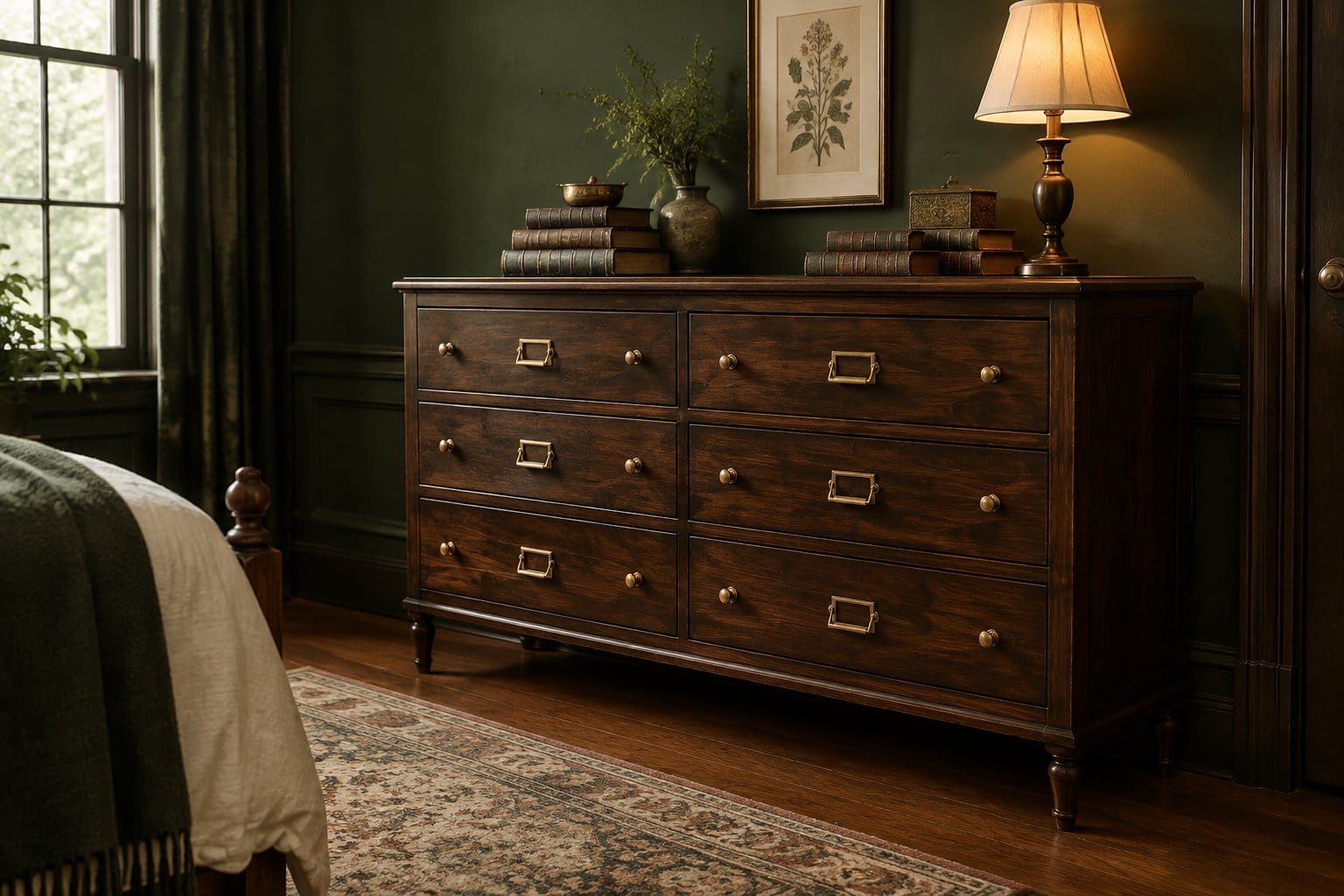
Swapping plain knobs for brass apothecary-style pulls is a twenty-minute upgrade that makes a basic dresser look like it came from an old pharmacy. Cup pulls and label-holder pulls, the kind with a little frame for a card, are the classic choices.
Before you buy anything, measure your existing hole spacing. Pulls are sized center-to-center, commonly 3 inches or 96mm. Matching your current holes means no drilling or filling. If you’re switching from single knobs to two-hole pulls, you’ll need a drill and a template.
To make it pop:
- Paint or stain the dresser a dark tone. Black-brown, deep green, or navy all work.
- Install aged brass or antique bronze pulls.
- Tuck handwritten cards into label-holder pulls (“Socks,” “Letters,” “Miscellany”).
Those little labels are charming and useful. Just resist the urge to label everything with fancy Latin, or you’ll forget where your pajamas live.
Renters can swap pulls on their own furniture freely. Keep the original hardware in a bag if you’ll resell the piece later.
17) Place a Vintage Globe on the Desk
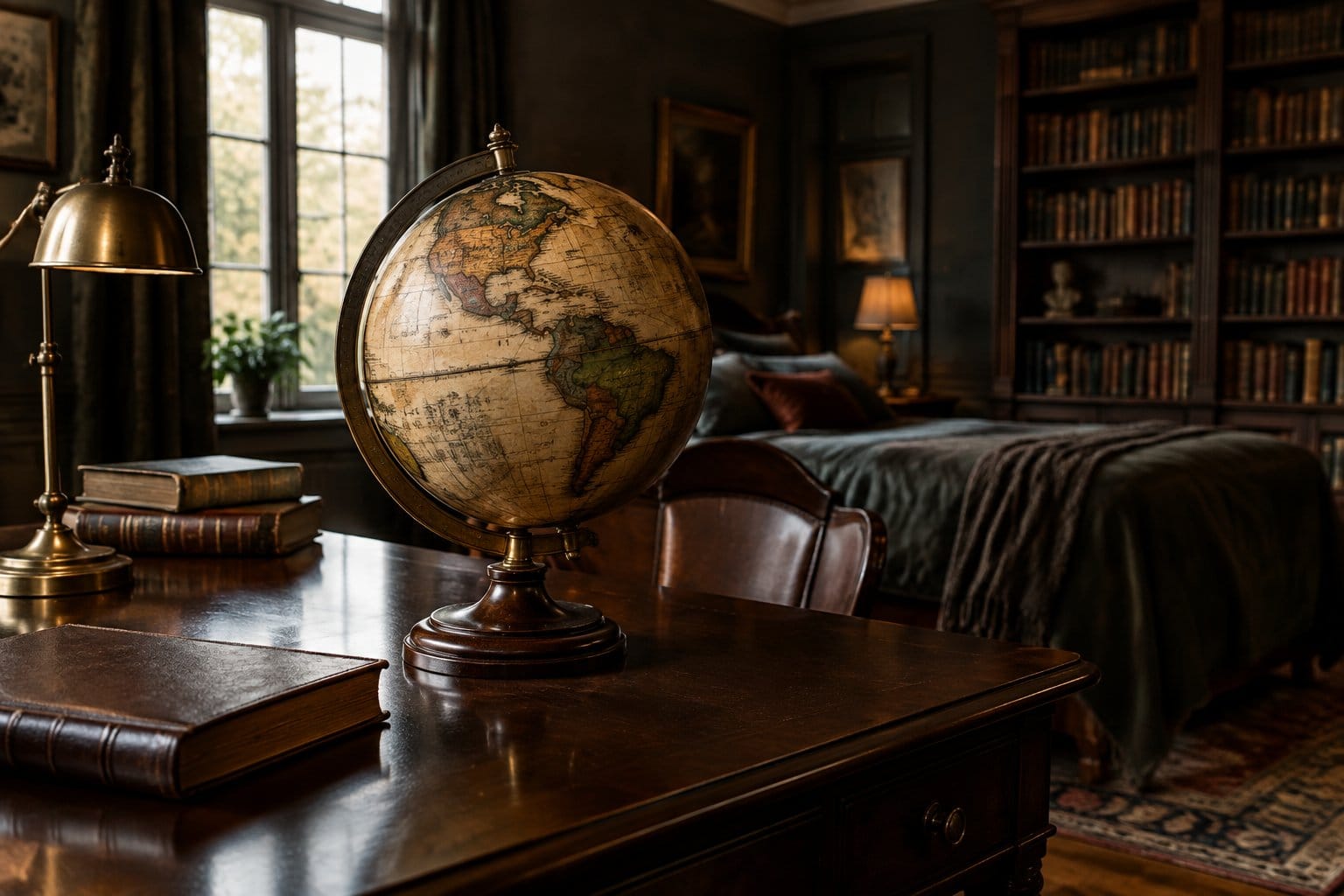
A vintage globe is the most instantly recognizable dark academia object, and it adds a rounded shape that breaks up all the rectangles of books, desks, and frames. Parchment-toned oceans and faded colors look best against dark wood.
Genuinely old globes can be collectible and expensive, especially pre-war ones. Mid-century school globes are far more affordable and still have that aged look. Reproduction “antique style” globes are easy to find new as well.
Sizing matters on a desk. A 12-inch globe with its stand takes up a surprising amount of room, so on a small writing desk, an 8- or 9-inch globe is plenty. Larger floor-standing globes suit reading corners next to a wingback chair.
Styling ideas:
- Set it on a short stack of books for height.
- Pair it beside your desk lamp so the light catches the curve.
- Group it with a magnifying glass or a brass letter opener.
Some reproduction globes open up to reveal hidden storage inside, handy for stashing chargers or small keepsakes.
18) Apply Stained-Glass Film to a Window
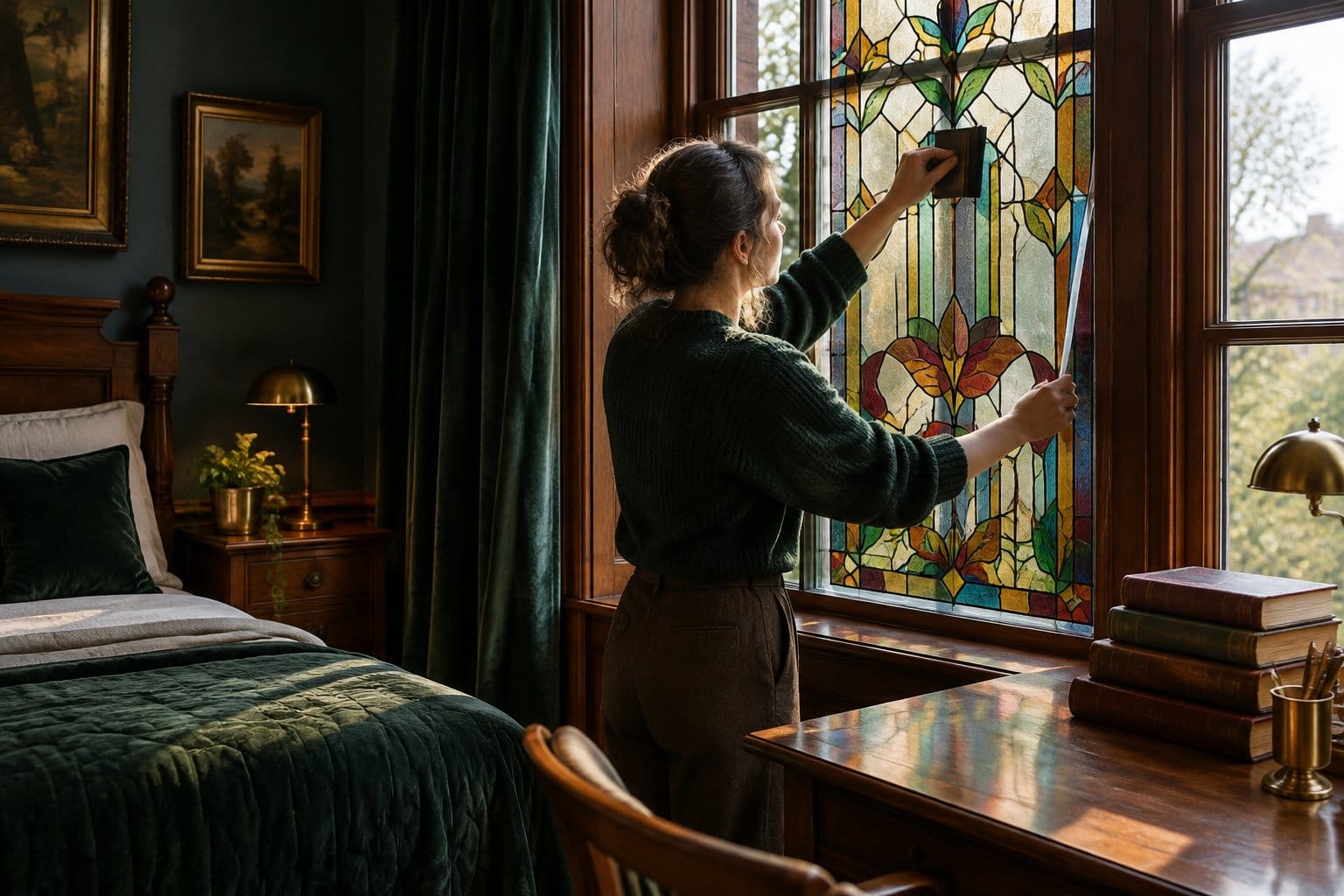
Stained-glass window film gives you the look of a chapel or old library window, and it peels off cleanly when you move. It’s one of the best renter-friendly tricks on this list and also adds privacy on street-facing windows.
Most films are static cling, meaning they hold to glass with water and no adhesive. To install:
- Clean the glass thoroughly, including the corners.
- Spray the glass with a mix of water and a drop of dish soap.
- Peel the backing and lay the film on, then squeegee from the center outward.
- Trim the edges with a sharp utility knife.
Consider the light trade-off. Colored film filters and tints incoming daylight. On your only window in a dark-painted room, cover just the upper third or a small transom pane so you keep plenty of daylight. On a secondary or side window, go full coverage.
Look for patterns with amber, deep green, and ruby tones. At sunset, the colored light falling across your floor is honestly one of the prettiest things you can add to a room.
19) Pair a Ceiling Medallion with a Schoolhouse Pendant
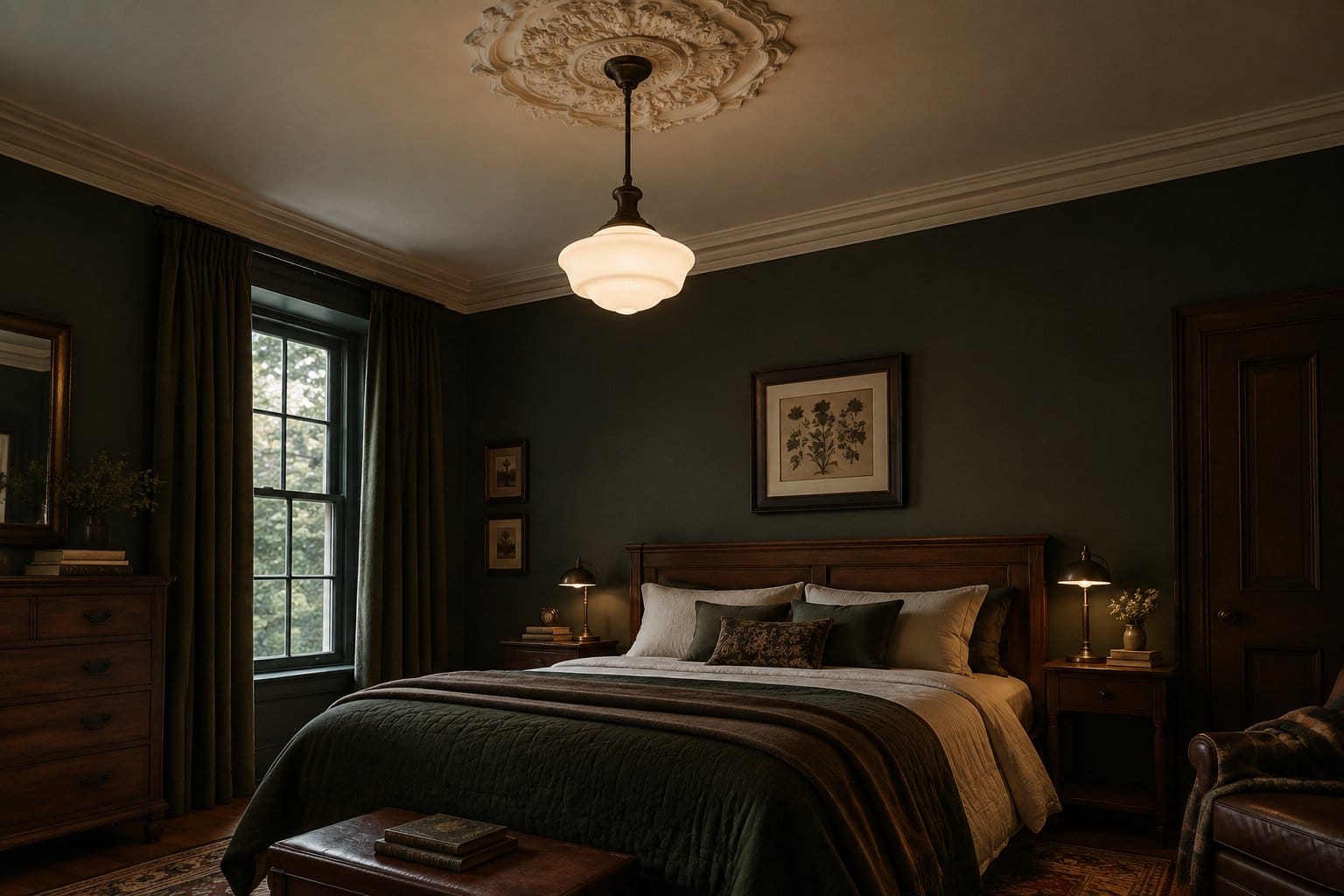
A ceiling medallion plus a schoolhouse pendant replaces a boring flush-mount with something that looks original to an old building. Schoolhouse lights, with their white milk-glass shades, were literally designed for classrooms, which makes them a perfect academic nod.
Ceiling medallions are lightweight polyurethane rosettes that glue around the fixture base. They’re inexpensive, and you can paint one to match your trim or pick out the details in gold.
Practical notes:
- Swapping a fixture involves wiring. If you’re not comfortable turning off the breaker and connecting wires, hire an electrician. It’s usually a quick job.
- Hang height: Keep the bottom of the pendant at least 7 feet from the floor in walkways.
- Pick a warm bulb to match your lamps so the room has one consistent glow.
Renters: ask your landlord before changing fixtures, and keep the original to reinstall later. Many will say yes to a like-for-like swap.
Save the overhead light for cleaning and finding lost socks. Use your lamps in the evening.
20) Mount a Dark Wood Peg Rail for Coats and Satchels
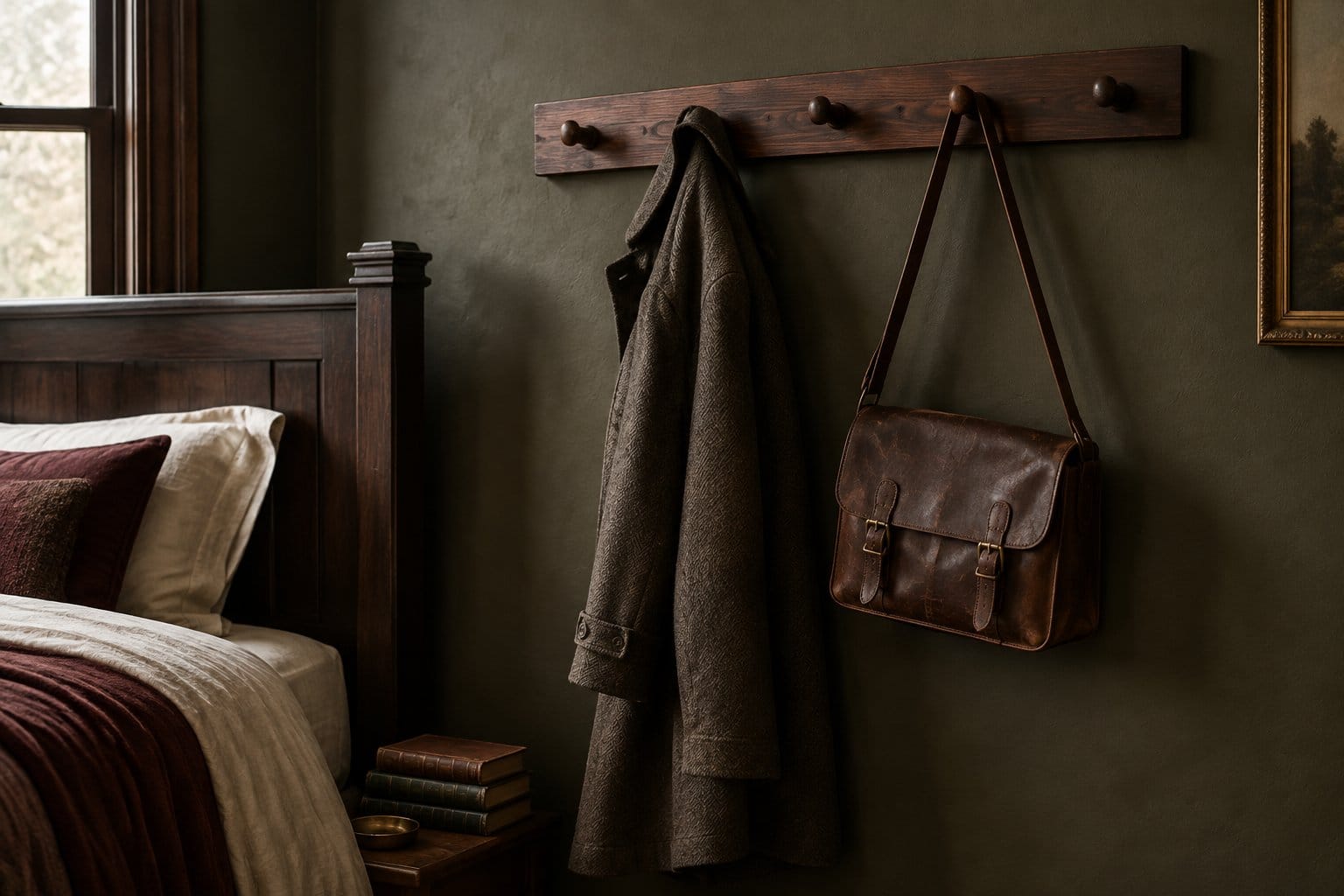
A Shaker-style peg rail gives your coats, scarves, and bags a home that looks deliberate. A tweed blazer and leather satchel hanging on the wall are décor in themselves.
Mount the rail about 60 to 66 inches from the floor for coats, or run it at chair-rail height (around 36 inches) along an entire wall for a more architectural look. Screw it into studs, because a rail loaded with wool coats and a book-filled bag is heavy.
You can buy pre-made peg rails, or build one from a pine board, wooden pegs, and a drill with a spade bit. Stain it dark walnut or paint it the same color as your walls for a seamless, built-in feel.
Renters who can’t drill much can hang a freestanding coat rack or use a few decorative hooks with fewer holes. For a moodier twist, these cast iron wall hooks hold heavy coats well.
Keep only in-season pieces on display. Six coats piled on one peg looks like a lost-and-found bin.
How to Make the Look Work in Your Bedroom
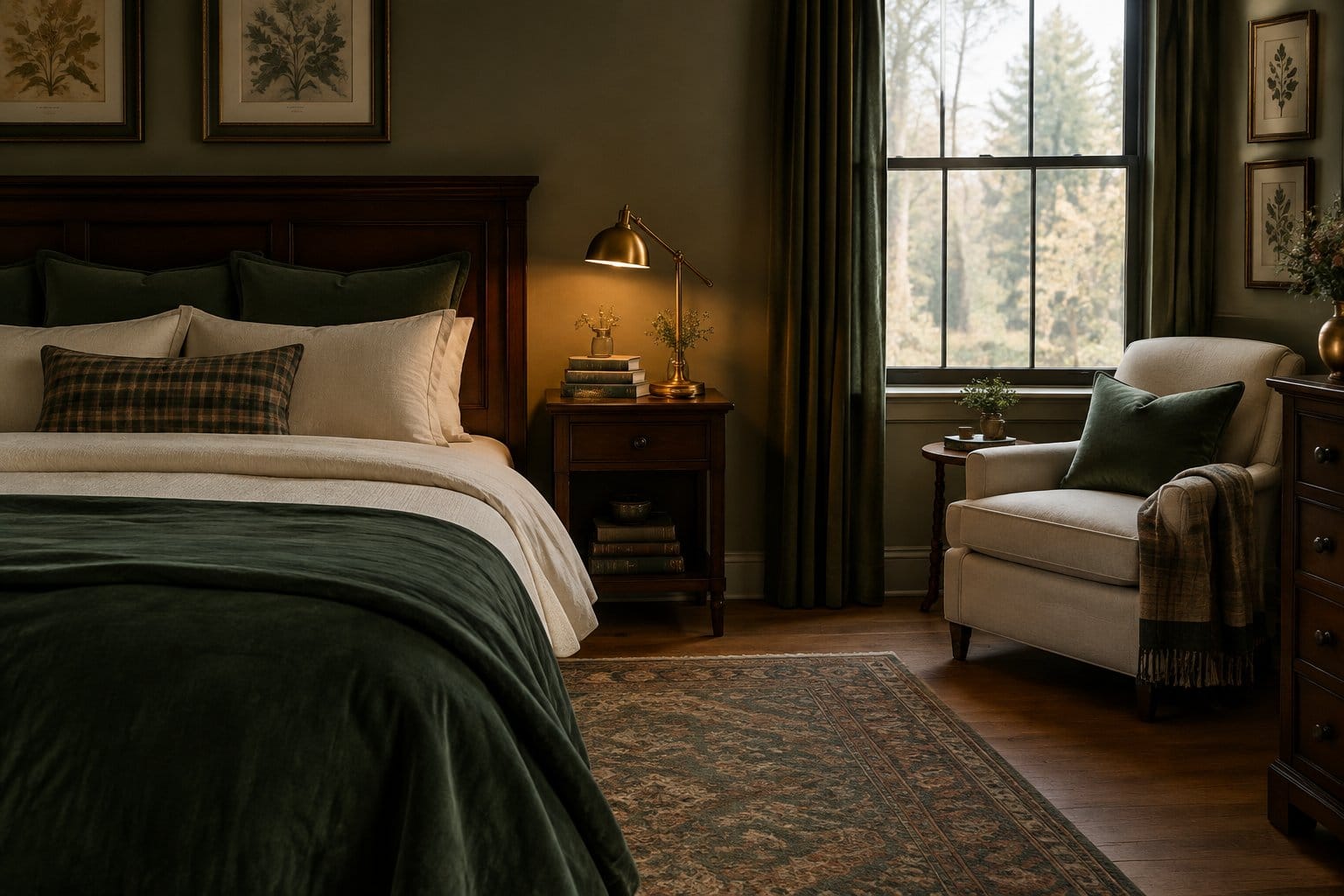
You get the best results by picking one anchor change and building around it, instead of buying twenty small things at once. The anchor might be paint, a bed, or shelving. Everything else layers on over weeks or months, which is how the rooms that feel collected are built anyway.
Here’s a quick reference for which ideas fit which situation:
| Idea | Cost | Renter-Friendly | Effort |
|---|---|---|---|
| Forest green paint | Low | Ask first | Weekend |
| Bookshelves around bed | Medium | Yes (anchored) | Weekend |
| Carved walnut bed | High | Yes | Moving day |
| Velvet bedding | Medium | Yes | Minutes |
| Writing desk | Low to medium | Yes | Minutes |
| Persian-style rug | Medium | Yes | Minutes |
| Velvet curtains | Medium | Yes | An hour |
| Brass lamps | Low to medium | Yes | Minutes |
| Wingback chair | Medium to high | Yes | Minutes |
| Tartan throw | Low | Yes | Minutes |
| Botanical prints | Low | Yes | An hour |
| Damask wallpaper | Low to medium | Yes | Afternoon |
| Gilded mirror | Medium | Yes | Minutes |
| Flameless tapers | Low | Yes | Minutes |
| Steamer trunk | Medium | Yes | Minutes |
| Apothecary pulls | Low | Yes | 20 minutes |
| Vintage globe | Low to medium | Yes | Minutes |
| Stained-glass film | Low | Yes | An hour |
| Medallion and pendant | Low to medium | Ask first | An hour plus wiring |
| Peg rail | Low | Few holes | An hour |
Where Should You Start If You Have a Small Budget?
Start with lighting, because it changes the mood of every other object in the room. Swap your bulbs for warm 2700K ones, add one brass lamp from a thrift store, and set up a pair of flameless tapers on a timer. That alone makes your existing room feel cozier.
Next, move on to textiles. A tartan throw and a couple of velvet pillow covers transform a plain bed for a small spend. Then pull every book you own out of boxes and closets and put them where you can see them, stacked on the nightstand, the floor, or the windowsill.
Thrift stores and estate sales are your best friends for the rest. Brass candlesticks, picture frames, small desks, and globes turn up constantly and cost far less secondhand. Browse the site’s home decor ideas for more ways to stretch a budget with moody pieces.
How Can You Keep a Dark Room from Feeling Cramped?
Layered light is the fix, so use at least three sources at different heights so no corner sits in shadow. Dark walls blur the room’s edges at night, which feels enveloping in a good way as long as there’s warm light pooling around.
A few more tricks:
- Choose leggy furniture. Desks, chairs, and nightstands on visible legs let the floor show underneath, which reads as more space.
- Use a big mirror across from or beside a window to bounce daylight.
- Keep trim and ceiling lighter. Cream trim and a pale ceiling stop the room from closing in overhead.
- Edit ruthlessly. One great chair beats a chair plus an ottoman plus a side table plus a plant stand.
Open your curtains fully during the day. Hanging the rod wide keeps the fabric off the glass, so you get every bit of daylight.
Which Changes Work Best in a Rental?
Most of this look is portable, which is great news if you rent. Textiles, lamps, rugs, mirrors, freestanding bookcases, the desk, the chair, and the trunk all move with you and require zero landlord approval.
For wall-level changes, peel-and-stick damask wallpaper and stained-glass window film both remove cleanly when you leave. Test wallpaper in a hidden corner first, since it can lift fresh or low-quality paint. Plug-in sconces add wall lighting without any wiring.
Paint and light fixtures are worth asking about. Many landlords approve paint if you agree to repaint before move-out, and a like-for-like pendant swap is often fine if you keep the original fixture. Get approval in writing, and take photos of the room before you change anything.
Frequently Asked Questions
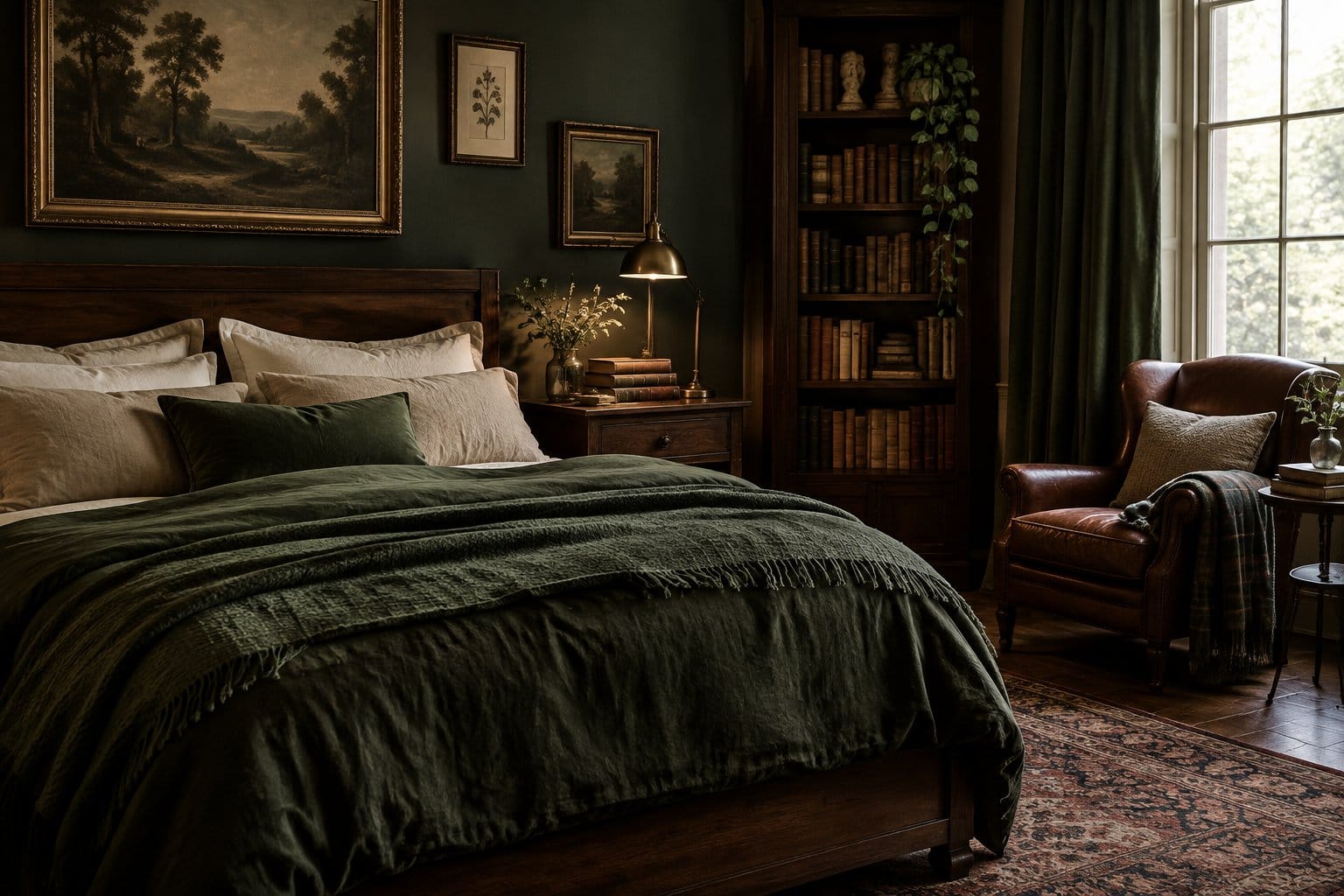
What are the key elements of a dark academia bedroom?
The essentials are deep wall colors, warm wood furniture, visible books, and warm, layered lighting. Add textured fabrics like velvet, wool, and leather, plus a few scholarly objects such as a globe, botanical prints, or brass candlesticks, and the look comes together.
What paint colors work best for a dark academia bedroom?
Forest green, burgundy, charcoal, deep navy, and warm chocolate brown are the most reliable choices. Pair any of them with cream or antique white trim to soften the contrast, and test swatches under your warm evening bulbs before committing.
What colors are appropriate for dark academia bedding?
Burgundy, forest green, navy, camel, and chocolate brown all suit the style, layered over white or cream sheets. Tartan, houndstooth, or subtle damask patterns work well as accents on throws and pillows.
How can I create a modern dark academia bedroom?
Keep the moody palette and warm lighting, then use cleaner-lined furniture and fewer ornate pieces. A simple wood platform bed, a sleek brass floor lamp, and a single large botanical print keep the mood while feeling current and less cluttered.
Can I get the dark academia look without buying antique furniture?
Yes. Paint, textiles, lighting, and books create most of the atmosphere, and none of those need to be antique. Thrifted pieces, reproduction hardware, and dark stain or paint on flat-pack furniture fill in the rest for a fraction of antique prices.